
TEXAS’S NEW RULE 166a WATCHLIST
Member Michael Duncan’s practice focuses heavily on appellate and motions practice, which means frequent work on summary judgment issues.
With changes to summary-judgment practice from the Texas Legislature in 2025 and the new Texas Rule 166a taking effect March 1st, he began digging into the impact of those changes and sharing those thoughts with colleagues. Recently, Duncan was asked to join the Texas Appellate Law Podcast for an in-depth discussion on the subject.
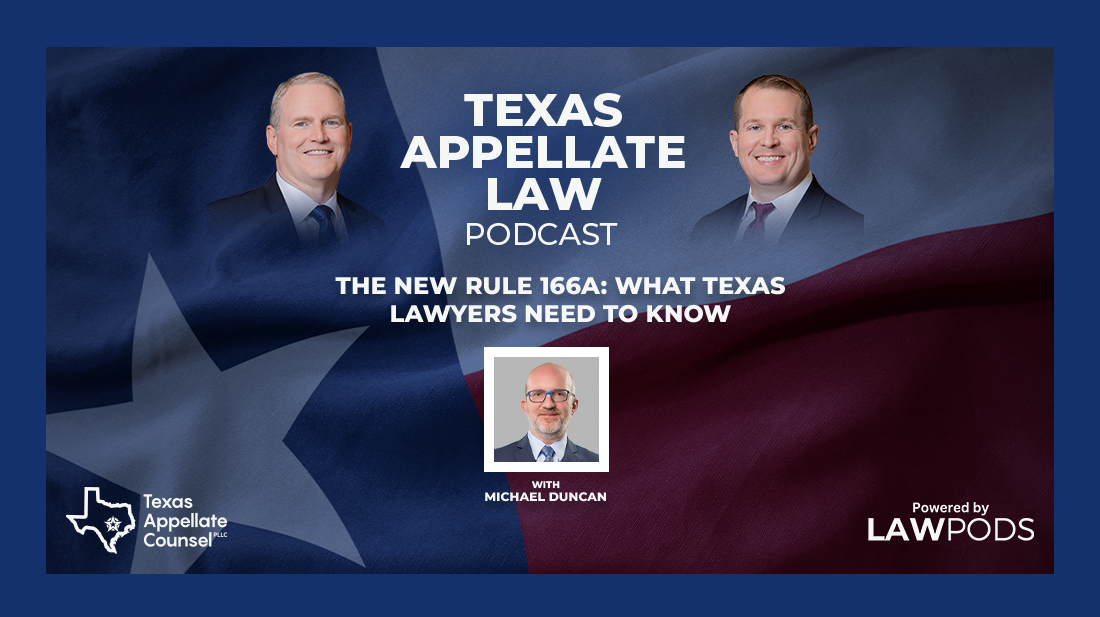
In the podcast, he shared a few things he’s watching closely and practical tools and tips to navigate the potential procedural changes.
He provides some of his observations and tips below:
Insight 1 – State Summary-Judgment Practice is now more like Federal Practice
The new rule requires responses within 21 days of a motion’s filing, and replies 7 days later.
Unlike the old rule, in which responses were not due until 7 days before a hearing, responses are now due 21 days from the date the motion is filed, and replies 7 days later. This is a major change in state-court practice and brings the procedure more in line with federal courts in Texas where the deadlines for responses are 21 days (Northern and Southern Districts) and 14 days (Eastern and Western Districts) from the date of the motion’s filing and replies are due 7 days later. This deadline may be extended by the court or by agreement of the parties, but parties should keep in mind the court’s new deadlines for hearing, which are statutory.
♦ HIS TAKEAWAY: CALENDAR YOUR DEADLINES UPON FILING OF A MOTION.
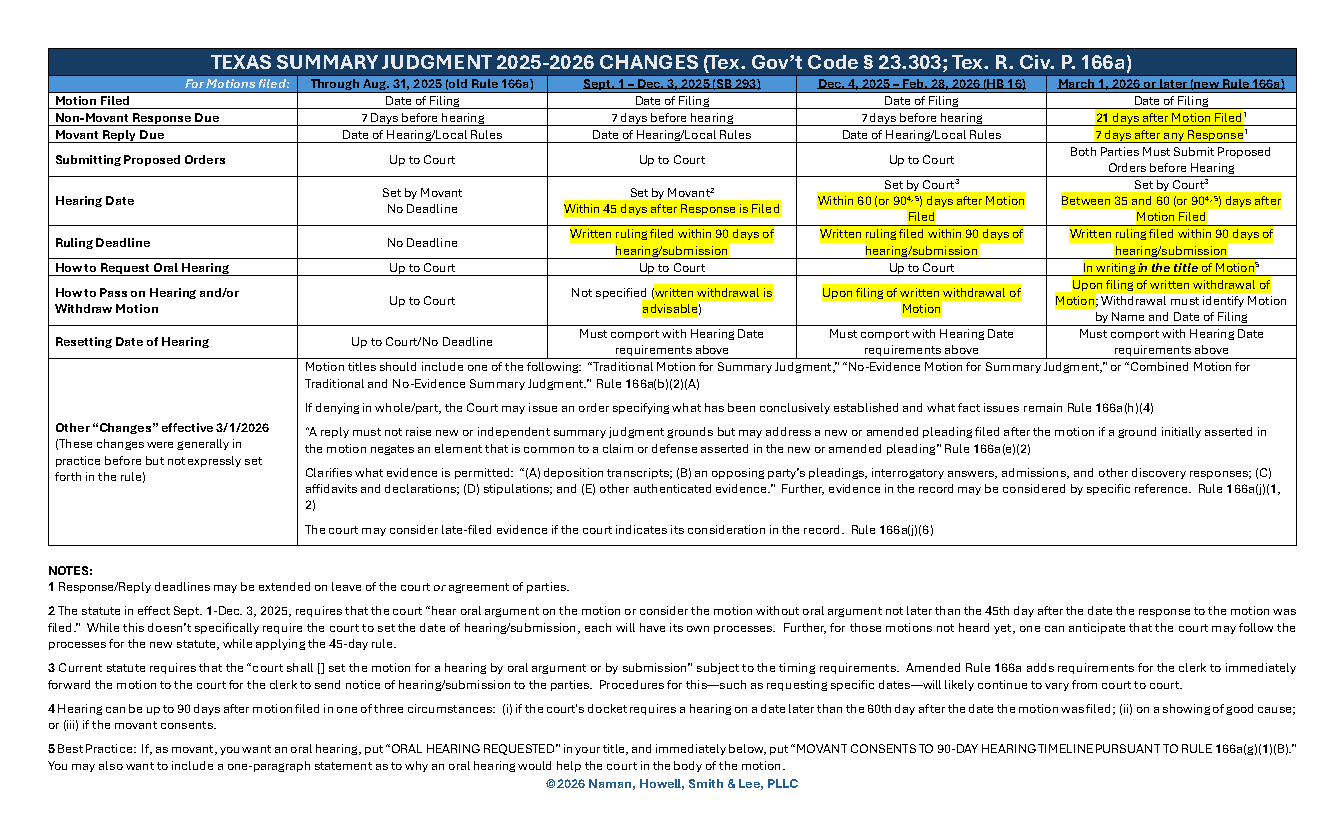
Insight 2 – Four Different Sets of Deadlines Apply, Depending on Date of Filing
Whether motion was filed before Aug. 1, 2025, before Dec. 4, 2025, before March 1, 2026, or after that will determine parties, and courts’ deadlines
The multiple changes and effective dates from the legislature have resulted not in just two sets of rules that apply (old and new), but four, depending on when the motion was filed. That means that until the older motions for summary judgment work their way out of the system—whether by hearing, settlement, or trial—attorneys need to be cognizant of the different rules that apply.
♦ HIS TAKEAWAY: PAY ATTENTION TO THE DATE THE MOTION WAS FILED. DUNCAN CREATED A ONE-PAGE CHART MAPPING OUT THE DIFFERENT CATEGORIES AND DEADLINES.
Insight 3 – The Courts’ 35-to-60-day Hearing Window has Additional Effects
It’s important to keep the hearing window in mind when entering a docket control order.
The minimum time for summary judgment is now longer than in the past. A court cannot hear the motion until the 35-to-60-day window, and the rule now contemplates up to 90 days for the court to take it under advisement, as many did before. These timelines should be taken into account by parties and courts when entering scheduling orders for a case so that the dispositive motion deadline is not too close to trial for the court to follow the rules.
♦ HIS TAKEAWAY: CONSIDER THE NEW DEADLINES FROM THE START.
Insight 4 – Sweat the Small Stuff
The new rule includes a number of important additional provisions.
The new rule includes a number of additional provisions which deserve attention. Parties must file proposed orders. Movants can agree to extend the hearing deadline to 90 days. Parties must request oral argument in the title. The title must clarify the type of summary judgment motion. The motion must be heard unless a written withdrawal is filed. Types of permissible evidence and how late-filed evidence is dealt with are discussed. Practitioners should make a thorough read of the new rule so they don’t miss out.
♦ HIS TAKEAWAY: DON’T LET THE DEVIL BE IN THE DETAILS; LEARN THE NEW RULE.
Insight 5 – Everyone is Learning
The new rule affects everyone. Work with the courts and other parties to ease the transition.
This is new ground for all participants. Movants. Non-movants. Judges. Everyone is trying to figure them out. It is important for the parties to communicate both among themselves and with the courts to clarify which rules apply to a particular motion so that everyone is on the same page.
♦ HIS TAKEAWAY: COMMUNICATE WITH THE PARTIES AND THE COURT ABOUT DEADLINES.
The Bottom Line
While the new Rule 166A doesn’t radically change the substance of summary judgment practice, it still represents a major update with new timelines, procedures, and a transition period that require careful attention.
From Duncan’s perspective, the practical approach is straightforward:
- Pay attention to when the MSJ was filed. Different dates mean different rules.
- Calendar the 21-day response and 7-day reply deadlines right away.
- Look out for the order from the court setting the hearing date.
- Communicate with the parties and the court about deadlines.
- Specify type of motion in the title.
- If you want oral argument, your motion title must specify that as well.
- As movant, agree to a 90-day hearing deadline if you are willing and able.
- File a proposed order with your motion or response.
- Withdrawals of motions must be in writing.
- Think about the new rule when agreeing to scheduling orders.
For more information about Michael Duncan, please visit his website bio HERE.
For more information about Naman Howell legal capabilities, please visit HERE.
About Naman Howell
Since 1917, Naman Howell Smith & Lee has provided individuals and businesses throughout Texas with the personal attentiveness and expertise they need on their legal matters when they need it most. We pride ourselves on our heritage, vision, and exceptional results. For more information about Naman Howell, please visit namanhowell.com.

